Washing the car in the driveway on a Sunday feels like one of those things that is yours to do however you like. In Sydney it is not quite that simple. There is a set of water rules and a set of pollution rules, and the second set has real fines attached to it.
The short version
- Sydney Water's Water Wise Rules apply every day, all year, across Greater Sydney. You can wash a car, but only with a bucket, a hose fitted with a trigger nozzle, or high pressure equipment.
- A hose left running without a trigger nozzle breaks the rules on its own, water restrictions or not.
- Soapy water that runs off your driveway does not go to a treatment plant. It goes straight down the stormwater drain and into the nearest creek, river or beach, untreated.
- NSW councils can issue penalty notices of up to $4,000 for letting wash water pollute a stormwater drain.
- Washing on the lawn, or having the car detailed with the water and products managed, keeps you clear of both sets of rules.
The water rules, and why they are permanent now
Greater Sydney runs on a standing set of water saving rules that do not switch off when the dams are full. Sydney Water calls them the Water Wise Rules, and they apply every day of the year. For a car, the rule is about how you deliver the water, not whether you are allowed to.
You are permitted to wash a vehicle of any kind using a bucket and sponge, a hose fitted with a trigger nozzle, or high pressure cleaning equipment. What you cannot do is leave a hose running on the ground or in your hand without a trigger nozzle on it. That single detail, a trigger nozzle, is the difference between a compliant wash and one that is against the rules.
The logic is simple. A running hose can pour through hundreds of litres while you scrub. A trigger nozzle turns the water off the moment you let go, so the only water you use is the water you are actually rinsing with. It is the cheapest change you can make and it happens to be the one the rules require.
The pollution rules are the ones with teeth
The water rules are about waste. The pollution rules are about where the dirty water goes, and this is where the real penalties live. When you wash a car on a driveway or the street, the runoff carries detergent, road grime, brake dust and oil into the gutter, and the gutter feeds the stormwater system.
Where your driveway water actually goes
Stormwater is not sewage. It is not treated. Everything that goes down a street drain flows, more or less directly, into the nearest creek and then to the harbour or the ocean. The soapy water off your car is in the surf at the local beach faster than most people would believe, still carrying whatever was on the paint and whatever was in the bottle.
It does measurable harm. Detergents that contain phosphates over fertilise the water and feed toxic algae, and the oils and micro plastics build up in the animals living in it. That is why councils such as North Sydney tell residents plainly not to wash the car on the street, and why NSW Environment recommends washing on grass or gravel, or using a car wash, instead.
And it is enforced. NSW councils can issue penalty notices of up to $4,000 for allowing wash water to pollute a stormwater drain. It is not a fine most people have heard of, right up until the one time somebody copies a licence plate and reports it.
It is worth remembering where that water ends up. In a coastal city the creek at the end of the street is a short run from a beach that people swim at. The soapy runoff from a driveway wash is not an abstract environmental point, it is the same water, a suburb or two downstream, that the harbour and the surf clubs spend their year trying to keep clean.
The frustrating part is that none of it is necessary. The detergent and grime that make the runoff a problem are exactly the things a controlled wash keeps out of it. Do the wash on grass, or with the water and products managed, and the pollution question simply does not come up. It is one of those rare cases where the compliant way and the better way are the same way.
What this means for a normal home wash
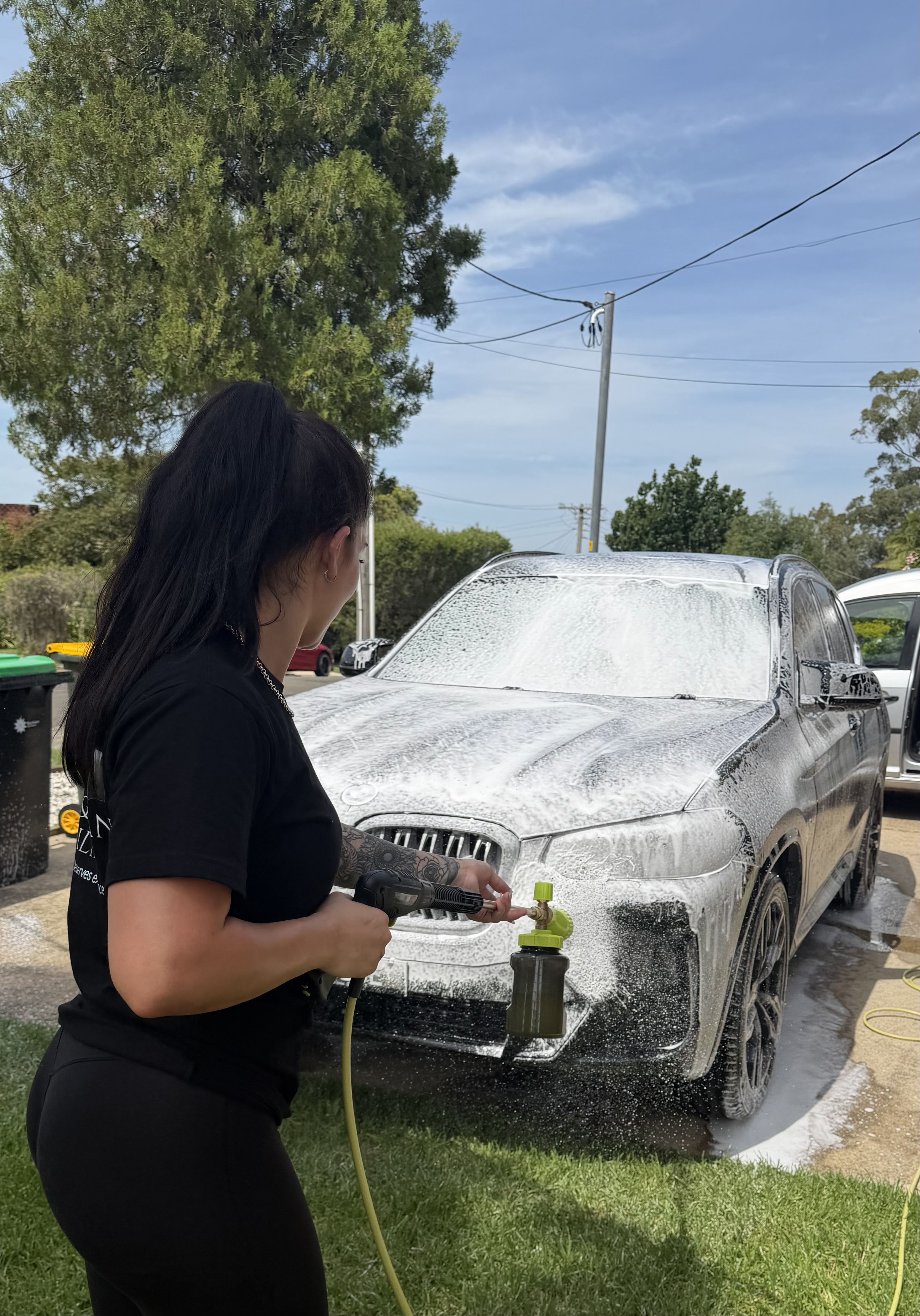
None of this means you cannot wash your own car at home. It means doing it in a way that keeps the water and the soap out of the drain. The single best move is to move the car off the concrete and onto the lawn, where the water soaks in and the grass gets the benefit instead of the creek.
The two bucket method
If you are washing by hand, use two buckets, one with your soap and one with clean water to rinse the mitt in between. It keeps the grit you just lifted off the paint out of the mitt, which is what stops the fine swirl marks that a single soapy bucket grinds back in. Use a pH balanced car soap, not dishwashing liquid, which strips wax and protection along with the dirt.
How a proper wash keeps you on the right side of it
This is where having the car detailed rather than hosed makes a practical difference, and not for the reason people assume. A professional wash uses less water, not more. A trigger nozzle or a low water rinseless method, pH correct products, and controlled rinsing all mean less runoff and far less detergent reaching the ground in the first place.
Because our maintenance cleans come to you, we bring the gear and the right products and can set up where the water is managed rather than sheeting off into the gutter. You get the wash done properly and you are not the one weighing up whether the driveway runoff is going to cost you a fine.
Why the automatic car wash is not the easy answer
The drive through wash looks like the compliant option, and on water it often is. The trouble is the brushes. The spinning brushes on many automatic washes drag grit across your paint car after car, and they are one of the most reliable ways to put swirl marks into a clear coat. If the finish matters to you, a proper hand wash or a full detail protects the paint in a way the tunnel never will.
How often a Sydney car actually needs washing
Once the how is sorted, the next question is how often, and Sydney gives a few pointers. A fair baseline for a car that is not coated is a proper wash every two weeks. Push that to weekly through the spring pollen months and the peak of summer, when the paint is under the most pressure, and stretch it a little for a car that lives in a garage.
A car with a ceramic coating is on a stricter schedule, because a coating only performs while it is kept clean. And a car that is already swirled or dull is a different job again, because a wash alone will not fix it. That is paint correction territory, where the marks are machined out of the clear coat rather than washed off the top of it.
There is a simple test for whether you are washing often enough. Run a clean hand over the paint after a wash. If it still feels rough, like fine sandpaper, that is bonded contamination the wash could not lift, and it means the car had gone too long between cleans. Smooth paint is a car on a good rhythm. Rough paint is a car that has been left.
The same goes for the drying. A lot of the fine marks people blame on the wash actually go in during the dry, when a rough or dirty towel is dragged over paint that still has grit on it. A clean, plush microfibre and a gentle touch, or a light spray to help it glide, is the last small step that decides whether the wash left the car better or quietly worse.
Products matter as much as method
The fastest way to ruin your own paint while trying to clean it is the wrong bottle. Dishwashing liquid strips wax and protection. A rough sponge or a single bucket drags grit back across the surface. A dirty chamois does the same on the dry. Good gear, a lambswool mitt, two buckets, a grit guard and a pH balanced soap, is cheap, and it is the difference between a wash that protects the paint and one that quietly wears it out.
It is the same logic as the pollution rules. The right method uses less water, less detergent and less force, which is better for the drain, better for the paint, and, as it happens, less work than fighting a running hose and a bucket of grey water.
Why a booked in clean beats good intentions
The honest problem with washing your own car is not knowledge, it is time. The fortnightly wash slips to monthly, monthly slips to whenever it looks bad, and by then the contamination has had weeks to bond on. A booked in maintenance clean takes the decision out of it. It happens on a rhythm, at your home or workplace, while you get on with the day.
That rhythm is what actually protects a car, far more than any single big detail does. A car washed properly every couple of weeks never gets the chance to get bad, and it never gives the driveway a reason to become a runoff problem either. You can see the standard we hold that work to in our recent jobs.
Where to start
If washing the car at home has become more hassle than it is worth, or you would rather it was done properly and compliantly, we come to you anywhere across Sydney, seven days a week. Every job is backed by our 100% satisfaction guarantee, and quotes are free before anything starts.
Tell us where the car is and what it needs, and we will bring the wash to your door. Get in touch for a free quote.